Story, World & Core Themes
Explore the narrative, setting, and ideas that shape Demon Slayer: Kimetsu no Yaiba.
Story
High-level synopsis and narrative focus.
A coming-of-age journey driven by family bonds and loss.
Demon Slayer: Kimetsu no Yaiba tells the story of a young boy’s journey through loss, responsibility, and resilience in a world threatened by demons.
After his family is killed in a brutal attack, Tanjiro Kamado discovers that his younger sister Nezuko has been transformed into a demon. Unlike others of her kind, Nezuko retains her emotions and refuses to harm humans. Determined to protect her and find a cure, Tanjiro joins the Demon Slayer Corps, an organization dedicated to eradicating demons.
As the story unfolds, Tanjiro travels across Japan, confronting increasingly powerful enemies while learning the true nature of demons, humanity, and compassion. Rather than focusing solely on good versus evil, the narrative explores the personal tragedies behind both heroes and villains, giving the series its emotional depth.
Demon Slayer: Kimetsu no Yaiba tells the story of a young boy’s journey through loss, responsibility, and resilience in a world threatened by demons.
After his family is killed in a brutal attack, Tanjiro Kamado discovers that his younger sister Nezuko has been transformed into a demon. Unlike others of her kind, Nezuko retains her emotions and refuses to harm humans. Determined to protect her and find a cure, Tanjiro joins the Demon Slayer Corps, an organization dedicated to eradicating demons.
As the story unfolds, Tanjiro travels across Japan, confronting increasingly powerful enemies while learning the true nature of demons, humanity, and compassion. Rather than focusing solely on good versus evil, the narrative explores the personal tragedies behind both heroes and villains, giving the series its emotional depth.
World
Setting, cultures, and distinctive elements.
A Taisho-era Japan shaped by folklore, demons, and swordsmanship.
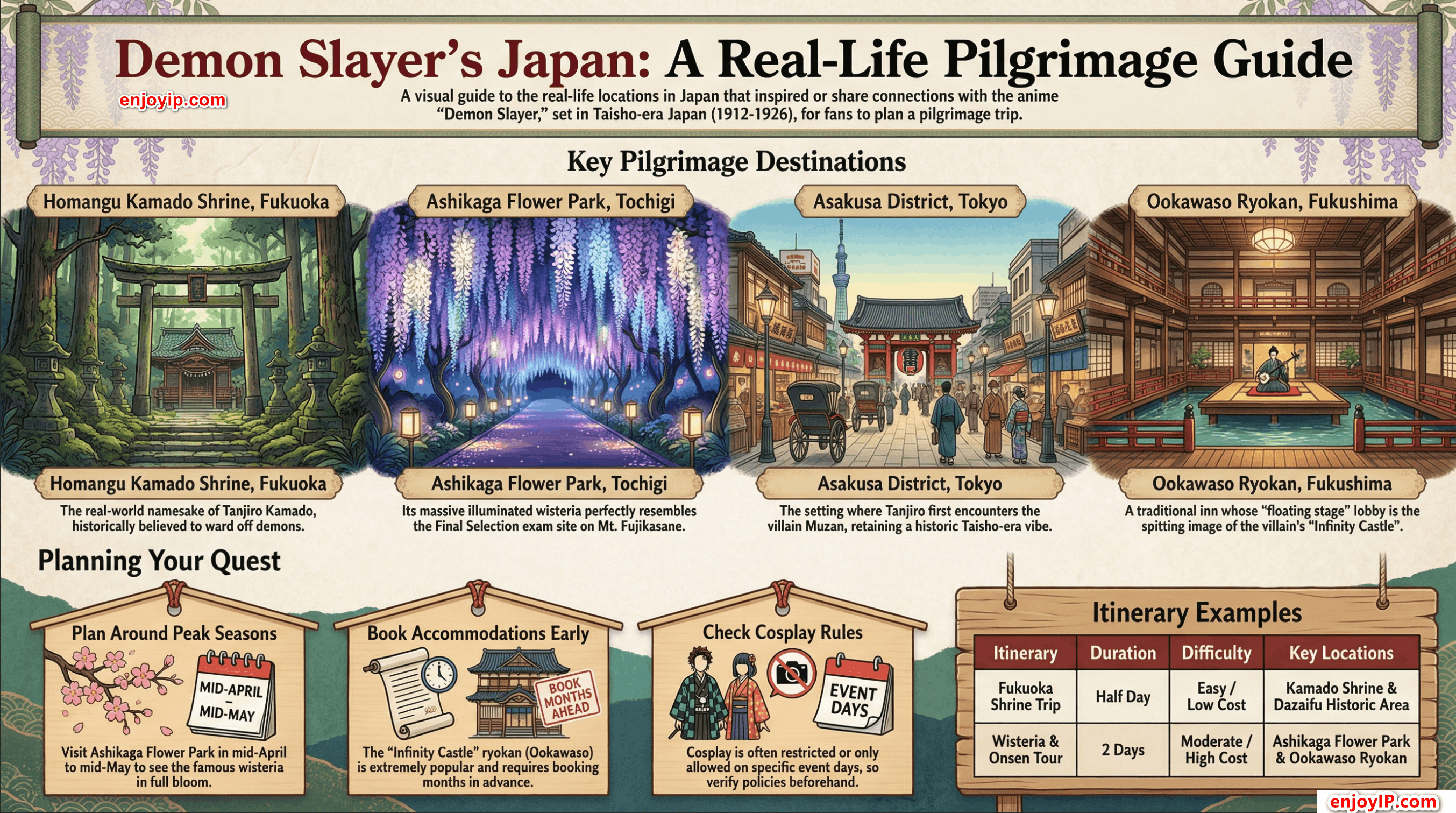
The world of Demon Slayer is inspired by Japan’s Taishō era (1912–1926), a period marked by rapid modernization and cultural transition.
Traditional elements such as rural villages, shrines, and swordsmanship coexist with early modern technology, creating a setting where the old and the new clash. Demons operate in the shadows, preying on humans at night, while most of society remains unaware of their existence.
The Demon Slayer Corps functions outside official government systems, relying on ancient techniques, secret training methods, and uniquely forged swords. Each swordsman uses a distinct Breathing Style, visually representing their fighting spirit and philosophy.
This blend of historical realism, folklore, and supernatural fantasy gives the world a grounded yet mythic atmosphere.
The world of Demon Slayer is inspired by Japan’s Taishō era (1912–1926), a period marked by rapid modernization and cultural transition.
Traditional elements such as rural villages, shrines, and swordsmanship coexist with early modern technology, creating a setting where the old and the new clash. Demons operate in the shadows, preying on humans at night, while most of society remains unaware of their existence.
The Demon Slayer Corps functions outside official government systems, relying on ancient techniques, secret training methods, and uniquely forged swords. Each swordsman uses a distinct Breathing Style, visually representing their fighting spirit and philosophy.
This blend of historical realism, folklore, and supernatural fantasy gives the world a grounded yet mythic atmosphere.
Themes
Core ideas and recurring motifs.
Family, perseverance, and the line between humanity and monstrosity.
At its core, Demon Slayer explores deeply human themes beneath its action-driven surface.
Family and Bonds
The emotional connection between siblings, mentors, and comrades drives many of the story’s most powerful moments. Family is portrayed not only as blood relations but also as bonds forged through shared hardship.
Compassion and Humanity
Even in battle, the series emphasizes empathy. Many antagonists are depicted as tragic figures, raising questions about morality, forgiveness, and the cost of survival.
Perseverance in the Face of Suffering
Characters endure overwhelming loss, pain, and fear, yet continue moving forward. Strength is defined not by invincibility, but by the refusal to give up.
Tradition versus Change
Set during a time of transformation, the story reflects tension between traditional values and a rapidly changing world, echoing the struggles of its characters.
At its core, Demon Slayer explores deeply human themes beneath its action-driven surface.
Family and Bonds
The emotional connection between siblings, mentors, and comrades drives many of the story’s most powerful moments. Family is portrayed not only as blood relations but also as bonds forged through shared hardship.
Compassion and Humanity
Even in battle, the series emphasizes empathy. Many antagonists are depicted as tragic figures, raising questions about morality, forgiveness, and the cost of survival.
Perseverance in the Face of Suffering
Characters endure overwhelming loss, pain, and fear, yet continue moving forward. Strength is defined not by invincibility, but by the refusal to give up.
Tradition versus Change
Set during a time of transformation, the story reflects tension between traditional values and a rapidly changing world, echoing the struggles of its characters.