Expect Busy Urban Locations
Shibuya, Harajuku, and Shinjuku are among the busiest areas in Tokyo. Early mornings or weekday afternoons generally provide a more relaxed experience for photography.
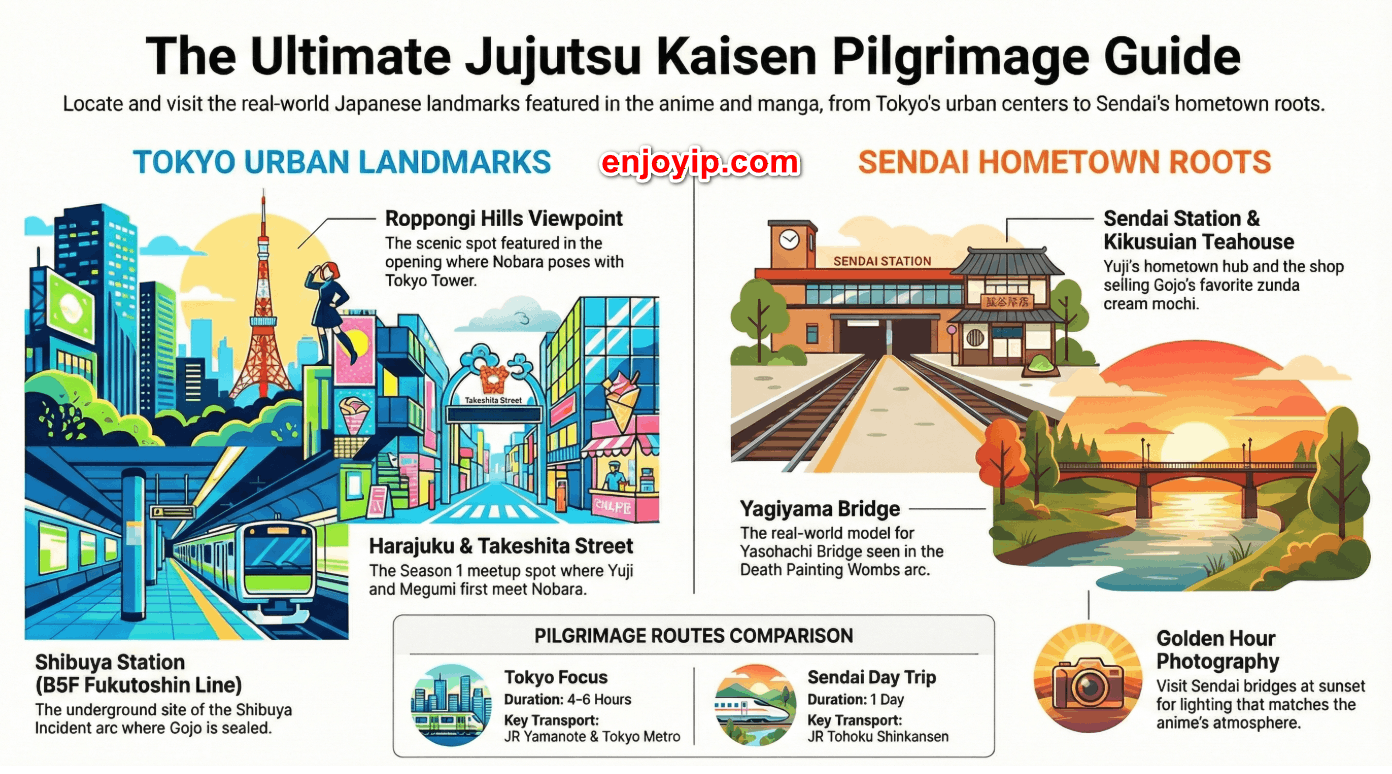
Jujutsu Kaisen (呪術廻戦) is a blockbuster anime and manga series by Gege Akutami, following Yuji Itadori as he joins the world of jujutsu sorcerers to battle curses born from human negativity. Set primarily in real Japanese locations like Tokyo, Sendai, and beyond, the series features highly accurate depictions of urban landmarks, making it perfect for anime pilgrimage (seichijunrei). Visiting these spots lets fans relive iconic scenes from the Shibuya Incident, character introductions, and more.

Step into the streets of Tokyo and Sendai where Jujutsu Kaisen brings supernatural battles into everyday urban life.
Unlike many anime set in fictional worlds, Jujutsu Kaisen places its sorcerers, curses, and high-stakes conflicts within real Japanese cities. From the vibrant streets of Harajuku to the underground platforms of Shibuya Station and the quieter neighborhoods surrounding Sendai, the series recreates familiar locations with remarkable architectural accuracy.
This pilgrimage offers a unique opportunity to experience modern Japan through the lens of one of the most influential shonen anime of the decade, where ordinary places become unforgettable battlefields.
| Anime | Jujutsu Kaisen |
|---|---|
| Creator | Gege Akutami |
| Primary Regions | Tokyo & Sendai |
| Recommended Trip Length | 2–3 Days |
| Transportation | JR Lines · Tokyo Metro · Sendai Subway |
| Best Seasons | Spring & Autumn |
Whether you're following Yuji Itadori's first days in Tokyo or retracing the events of the Shibuya Incident, this journey combines world-famous landmarks with locations that feel surprisingly familiar to everyday commuters.
Few anime blend fantasy and reality as seamlessly as Jujutsu Kaisen.
Rather than creating an entirely fictional setting, the series transforms real railway stations, shopping streets, office buildings, pedestrian tunnels, and city intersections into stages for supernatural battles. The result is a pilgrimage where fans can stand in places that look strikingly similar to their animated counterparts.
Another distinctive feature is the contrast between ordinary daily life and extraordinary events. A busy subway platform, a fashionable shopping street, or a quiet urban tunnel may appear completely normal until viewers remember the scenes that unfolded there.
The pilgrimage also reflects the evolution of the story itself. Early locations in Harajuku and central Tokyo capture the excitement of Yuji's introduction to the world of jujutsu, while Shibuya becomes the setting for one of modern anime's most acclaimed story arcs. Fans seeking a deeper connection can extend their journey to Sendai, the city closely associated with Yuji Itadori's hometown.
Many of Jujutsu Kaisen's locations are active transport hubs and commercial districts rather than traditional tourist attractions.
A little planning will help you enjoy the pilgrimage while respecting the people who use these places every day.
Shibuya, Harajuku, and Shinjuku are among the busiest areas in Tokyo. Early mornings or weekday afternoons generally provide a more relaxed experience for photography.
Several iconic locations are inside or immediately adjacent to operating train stations. Follow station regulations, avoid obstructing commuters, and never cross safety barriers for photographs.
Some of the most rewarding locations are found by walking between major landmarks. Side streets, pedestrian bridges, and smaller shopping areas often reveal details that closely resemble the anime.
While Tokyo contains the majority of pilgrimage sites, Sendai offers a different perspective on the series through locations connected with Yuji Itadori's background and regional references. Combining both cities creates a more complete pilgrimage experience.
Most locations are easily reached by public transportation and involve a significant amount of walking. Comfortable footwear and a rechargeable transit card such as Suica or PASMO will make getting around much easier.
One of Jujutsu Kaisen's greatest strengths is how convincingly it transforms modern Tokyo into a world where the supernatural exists just beyond everyday life.
Busy stations become battlefields. Underground platforms hide deadly confrontations. Quiet tunnels and ordinary intersections suddenly feel mysterious once viewed through the series.
Rather than separating fantasy from reality, the anime invites viewers to imagine that curses could exist within the familiar rhythm of daily urban life. Walking these same streets allows fans to appreciate the remarkable level of environmental research behind the series while experiencing Tokyo from an entirely new perspective.
Click the □ icon in the top-left corner of the map to expand the list of anime titles.
Check or uncheck a title to show or hide its pilgrimage locations (multiple selections supported).
Curated videos and routes — click a card to watch and plan your trip.

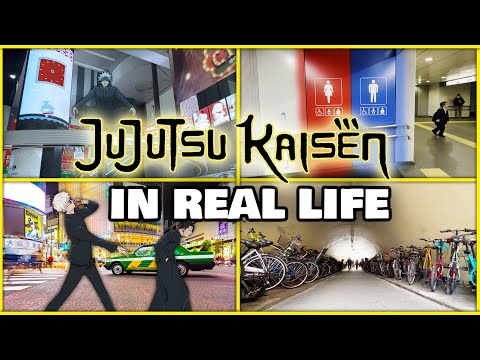
One of the earliest real-world Jujutsu Kaisen settings, where Harajuku's station entrances, crowded shopping streets, and youthful Tokyo energy frame the series' blend of everyday life and hidden supernatural danger.
Trip Facts
Admission
Free
Travel Snapshot
Key planning details for this stop, organized like a quick on-the-go pilgrimage guide.
Where
Harajuku Station & Takeshita Street
Getting There
Directly outside JR Harajuku Station
For Photographers
The area offers countless opportunities for comparison photography, especially if you treat the station plaza and the entrance to Takeshita Street as part of one wider streetscape.
Where Everyday Tokyo Meets the World of Jujutsu
Located between <strong>Shibuya</strong> and <strong>Yoyogi</strong>, <strong>Harajuku Station</strong> and the neighboring <strong>Takeshita Street</strong> form one of the earliest real-world settings featured in <em>Jujutsu Kaisen</em>. This lively district, famous for youth culture, fashion, and constant pedestrian activity, provides the backdrop for Yuji Itadori, Megumi Fushiguro, and Nobara Kugisaki during one of their first missions together.
Rather than portraying a fantasy city, the series places supernatural events within one of Tokyo's most recognizable neighborhoods. Familiar station entrances, crowded shopping streets, and everyday urban scenery create a striking contrast between ordinary life and the hidden world of curses.
Today, Harajuku remains one of the easiest <em>Jujutsu Kaisen</em> locations to visit, allowing fans to experience the same energetic atmosphere that appears throughout the anime.
Harajuku represents an important stage in the story's early development.
As Yuji begins adapting to life as a jujutsu sorcerer, the series repeatedly places him in real urban environments where ordinary people continue their daily routines, unaware of the supernatural battles happening around them.
This blend of realism and fantasy is one of <em>Jujutsu Kaisen</em>'s defining strengths. Instead of isolating its characters in fictional worlds, the anime transforms familiar locations into settings where extraordinary events unfold just out of sight.
Harajuku perfectly captures that balance, combining Tokyo's youthful energy with the tension that defines the series.
Scene Highlights
While individual businesses naturally change over time, the district's overall layout and energy remain immediately recognizable. This is the kind of location where the atmosphere matters just as much as any single frame match.
The area offers countless opportunities for comparison photography, especially if you treat the station plaza and the entrance to Takeshita Street as part of one wider streetscape.
Harajuku is one of Tokyo's busiest shopping districts, so visiting responsibly makes a real difference to both the experience and the surrounding neighborhood.
Just a short walk from Harajuku Station, this historic shrine provides a peaceful contrast to the busy shopping streets and is one of Tokyo's most important cultural landmarks.
Ideal if you want a calmer stop after the crowds of Takeshita Street.
Known for contemporary architecture and upscale boutiques, Omotesando offers another perspective on central Tokyo and frequently appears in modern visual media.
A useful extension if you want more urban architecture and design-focused photography.
Only one station away on the JR Yamanote Line, Shibuya is home to many of Jujutsu Kaisen's most iconic locations, especially those connected with the Shibuya Incident Arc.
A natural next stop if you are building a full Tokyo JJK route.
| Anime Connection | ⭐⭐⭐⭐☆ |
|---|---|
| Atmosphere | ⭐⭐⭐⭐⭐ |
| Photography | ⭐⭐⭐⭐☆ |
| Accessibility | ⭐⭐⭐⭐⭐ |
| Cultural Context | ⭐⭐⭐⭐☆ |
| Time Required | 45–90 Minutes |
Harajuku is one of the best places to experience what makes <em>Jujutsu Kaisen</em> unique. Rather than relying on grand fantasy landscapes, the series builds its world within the familiar streets of modern Tokyo. Walking through Harajuku allows fans to appreciate how carefully Gege Akutami's world, and MAPPA's adaptation, integrate supernatural storytelling into one of Japan's most recognizable urban neighborhoods.
The underground heart of the Shibuya Incident, where one of Tokyo’s busiest commuter spaces becomes the setting for some of Jujutsu Kaisen’s most memorable confrontations.
Trip Facts
Admission
Valid train ticket or station entry ticket may be required to access paid areas
Travel Snapshot
Key planning details for this stop, organized like a quick on-the-go pilgrimage guide.
Where
Tokyo Metro Fukutoshin Line Platforms (B5 Level), Shibuya Station
Getting There
Direct access via Tokyo Metro Fukutoshin Line; connected to JR, Tokyu, Keio Inokashira Line, and other subway lines
For Photographers
Photography inside Japanese railway stations is generally permitted for personal use, but it should always be done responsibly and with commuter safety in mind.
The Heart of the Shibuya Incident
Hidden beneath one of Tokyo's busiest transportation hubs, the <strong>Fukutoshin Line platforms at Shibuya Station</strong> served as one of the primary real-world inspirations for the dramatic underground scenes in <em>Jujutsu Kaisen</em>'s <strong>Shibuya Incident Arc</strong>.
While the anime adapts the station's layout to suit the story, many architectural features, including the wide platforms, underground corridors, escalators, and modern station design, closely resemble the real location. For fans, this station represents one of the most recognizable examples of how the series transforms an ordinary public space into the setting for an extraordinary supernatural conflict.
Today, Shibuya Station remains one of the most visited pilgrimage destinations for <em>Jujutsu Kaisen</em> fans exploring Tokyo.
The Shibuya Incident marks a turning point in both the anime and manga.
Many of the arc's most memorable confrontations take place within Shibuya Station's underground network, where familiar commuter spaces become the stage for battles involving powerful curses, jujutsu sorcerers, and thousands of trapped civilians.
Choosing a real transportation hub makes these scenes especially impactful. Every day, millions of passengers move through Shibuya Station, making it easy for viewers to imagine the extraordinary events unfolding beneath one of Tokyo's busiest districts.
Scene Highlights
Although certain layouts were modified for dramatic storytelling, the overall design strongly reflects the real station. This is one of the clearest examples of Jujutsu Kaisen using everyday urban infrastructure as the foundation for a major supernatural arc.
Photography inside Japanese railway stations is generally permitted for personal use, but it should always be done responsibly and with commuter safety in mind.
Because this is one of Tokyo's busiest transit facilities, minimizing disruption should always take priority over scene recreation.
One of the world's most famous intersections and an essential stop for fans exploring the Shibuya Incident Arc.
Best paired with the underground station stop to experience the arc above and below street level.
Located outside the station, this iconic meeting point has become one of Tokyo's best-known landmarks.
A natural landmark stop while moving through Shibuya on foot.
A lively shopping and entertainment district whose atmosphere closely matches the urban energy portrayed throughout the series.
Useful for extending the pilgrimage into the broader Shibuya cityscape.
A modern mixed-use complex offering rooftop spaces, restaurants, and excellent views of central Shibuya.
A good contrast if you want to move from underground tension to open city views.
| Anime Connection | ⭐⭐⭐⭐⭐ |
|---|---|
| Atmosphere | ⭐⭐⭐⭐⭐ |
| Photography | ⭐⭐⭐☆☆ |
| Accessibility | ⭐⭐⭐⭐⭐ |
| Story Importance | ⭐⭐⭐⭐⭐ |
| Time Required | 20–40 Minutes |
Unlike scenic pilgrimage destinations, Shibuya Station demonstrates one of <em>Jujutsu Kaisen</em>'s greatest strengths: its ability to transform familiar urban infrastructure into a believable supernatural battlefield. For commuters, the platforms are simply part of daily life. For fans, they represent the beginning of one of modern anime's most influential story arcs.
A character-focused pilgrimage stop that connects fans with Yuji Itadori’s hometown roots through Sendai Station, regional atmosphere, and the famous Kikufuku sweet at Kikusuian.
Trip Facts
Admission
Station access is free; food purchases optional
Travel Snapshot
Key planning details for this stop, organized like a quick on-the-go pilgrimage guide.
Where
Sendai Station & Kikusuian
Getting There
Directly inside JR Sendai Station
For Photographers
Unlike many pilgrimage locations, this stop focuses more on atmosphere, regional identity, and food culture than on exact scene recreation.
Discover Yuji Itadori's Hometown Connections
Located in <strong>Miyagi Prefecture</strong>, <strong>Sendai Station</strong> serves as the gateway to one of the most meaningful destinations for <em>Jujutsu Kaisen</em> fans. While most of the series takes place in Tokyo, Sendai holds special significance as the hometown associated with <strong>Yuji Itadori</strong>, connecting visitors to the character's life before becoming a jujutsu sorcerer.
Just inside the station, fans can also visit <strong>Kikusuian (喜久水庵)</strong>, the tea house famous for its signature sweet, <strong>Kikufuku</strong>. Although the shop itself does not appear directly in the anime, the confection became widely known after being mentioned in the manga, turning it into one of the franchise's most beloved real-world culinary connections.
Together, Sendai Station and Kikusuian offer a pilgrimage focused not on recreating battle scenes, but on exploring the cultural roots behind one of the series' central characters.
Unlike Tokyo's action-filled locations, Sendai represents the quieter side of <em>Jujutsu Kaisen</em>.
Before entering the world of curses, Yuji lived an ordinary life in Miyagi Prefecture. Visiting Sendai provides valuable context for his background and highlights the contrast between his peaceful hometown and the extraordinary events that follow.
For many fans, the city offers a chance to experience the everyday Japan that shaped Yuji long before he became a jujutsu sorcerer.
The Story Behind Kikufuku
While enjoying Kikufuku, visitors are not only following a manga reference. They are also experiencing a long-standing Sendai specialty that locals have loved for years, which gives the stop more cultural depth than a simple franchise tie-in.
Unlike many pilgrimage locations, this stop focuses more on atmosphere, regional identity, and food culture than on exact scene recreation.
Kikusuian is a long-established tea house serving both local residents and visitors, so a respectful approach helps keep the experience welcoming for everyone.
Located within walking distance of the station, this lively market offers fresh seafood, local produce, and regional specialties.
A great add-on if you want more local food culture beyond Kikufuku.
One of Sendai's best-known historical attractions, providing panoramic views over the city.
Useful for adding historical context and a broader city perspective to the day.
A tree-lined boulevard famous for its seasonal scenery and one of Sendai's most pleasant walking streets.
Best if you want a more relaxed city walk after the station stop.
The ornate resting place of Date Masamune, offering insight into the city's rich history and culture.
A strong extension if you want to connect anime travel with regional heritage.
| Character Connection | ⭐⭐⭐⭐⭐ |
|---|---|
| Food Experience | ⭐⭐⭐⭐⭐ |
| Atmosphere | ⭐⭐⭐⭐☆ |
| Accessibility | ⭐⭐⭐⭐⭐ |
| Scene Accuracy | ⭐⭐⭐☆☆ |
| Time Required | 30–60 Minutes |
Unlike locations recreated scene-for-scene in the anime, Sendai Station and Kikusuian are best understood as character heritage destinations. Their importance comes from the connection to Yuji Itadori's hometown and the manga's reference to Kikufuku, giving fans a deeper appreciation of the regional influences that helped shape one of <em>Jujutsu Kaisen</em>'s most beloved characters.
A real Sendai bridge widely believed by fans to have helped inspire the fictional Yasohachi Bridge, offering dramatic valley views and a strong sense of early-series mystery.
Trip Facts
Admission
Free
Travel Snapshot
Key planning details for this stop, organized like a quick on-the-go pilgrimage guide.
Where
Yagiyama Bridge
Getting There
Reachable by bus or taxi from Sendai Station; approximately 15–20 minutes depending on traffic
For Photographers
The bridge offers excellent opportunities for landscape photography, especially when you treat the valley and surrounding topography as part of the story, not just the bridge itself.
A Real Bridge Believed to Inspire One of Jujutsu Kaisen's Most Memorable Locations
Spanning the Hirose River in Sendai, <strong>Yagiyama Bridge (八木山橋)</strong> is widely regarded by fans as one of the real-world inspirations for the fictional <strong>Yasohachi Bridge (八十八橋)</strong> featured in <em>Jujutsu Kaisen</em>.
Although <strong>Gege Akutami has not officially confirmed the connection</strong>, the similarities in the bridge's structure, surrounding valley, and elevated viewpoint have made it a popular pilgrimage destination among fans exploring Yuji Itadori's hometown.
Rather than serving as a direct scene recreation, Yagiyama Bridge offers an opportunity to experience the kind of landscape that may have influenced one of the series' early supernatural settings.
The Yasohachi Bridge story is one of the earliest investigations that introduces viewers to the darker side of the <em>Jujutsu Kaisen</em> universe.
Set around a mysterious bridge associated with unexplained disappearances and cursed energy, the arc establishes many of the supernatural themes that define the series.
While the fictional bridge differs in layout and narrative details, Yagiyama Bridge shares a similar atmosphere: an elevated structure crossing a deep river valley, creating a dramatic setting that naturally lends itself to mystery and suspense.
For many fans, visiting the bridge is less about finding an exact anime scene and more about appreciating the environmental inspiration behind the story.
Inspiration Rather Than Recreation
Understanding the bridge as a possible source of inspiration rather than a one-to-one recreation makes the visit more rewarding. It encourages fans to appreciate both the real location and the creative process behind the fictional world.
The bridge offers excellent opportunities for landscape photography, especially when you treat the valley and surrounding topography as part of the story, not just the bridge itself.
Safety should always take priority here, because this is an active public roadway used by vehicles, cyclists, and pedestrians.
Located nearby, the historic castle site offers panoramic views of Sendai and makes an excellent addition to the same itinerary.
Good if you want a second elevated viewpoint in the city.
Enjoy riverside walking paths that showcase another side of Sendai's natural landscape.
A strong add-on for visitors who want a slower and more scenic walk.
One of Sendai's best-known family attractions, located within the same district.
Useful if you are already spending more time in the Yagiyama area.
Approximately 20–30 minutes away by public transportation, making it easy to combine both destinations in a single day.
Pairs well with Kikusuian and Yuji-related hometown exploration.
| Possible Anime Inspiration | ⭐⭐⭐⭐☆ |
|---|---|
| Atmosphere | ⭐⭐⭐⭐☆ |
| Photography | ⭐⭐⭐⭐☆ |
| Accessibility | ⭐⭐⭐☆☆ |
| Worldbuilding Value | ⭐⭐⭐⭐⭐ |
| Time Required | 20–40 Minutes |
Unlike officially identified anime locations, Yagiyama Bridge represents a different type of pilgrimage experience. Its significance comes from the similarities that fans have observed between the real bridge and the fictional Yasohachi Bridge, making it best appreciated as a possible source of inspiration that reveals how real landscapes can influence manga and anime worldbuilding.
A modern Tokyo landmark whose skyline, architecture, and surrounding streets help establish the grounded metropolitan setting that defines Jujutsu Kaisen.
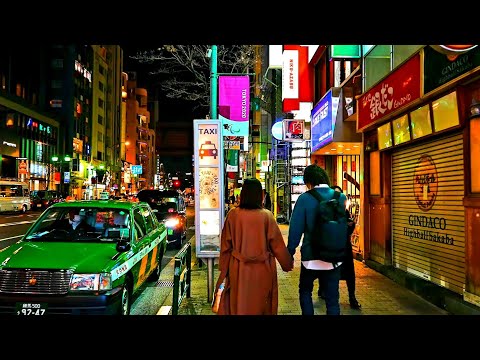
Trip Facts
Admission
Public areas are free; individual attractions require separate admission
Travel Snapshot
Key planning details for this stop, organized like a quick on-the-go pilgrimage guide.
Where
Roppongi Hills
Getting There
About 3 minutes on foot from Roppongi Station (Tokyo Metro Hibiya Line / Toei Oedo Line)
For Photographers
The most effective photos here combine the architecture of Roppongi Hills with the surrounding skyline, rather than isolating one facade on its own.
A Modern Tokyo Landmark That Sets the Stage
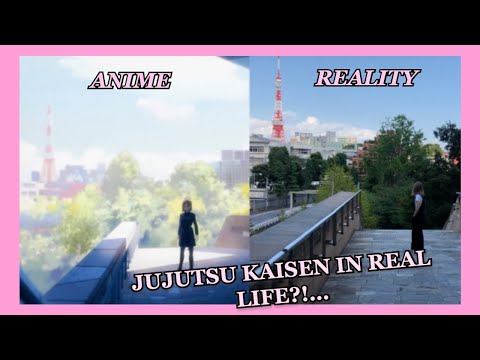
Rising above the Minato district, <strong>Roppongi Hills</strong> is one of Tokyo's most recognizable urban landmarks and appears in <em>Jujutsu Kaisen</em> as part of the series' realistic portrayal of the city. Its distinctive skyline, modern architecture, and surrounding streets help establish the metropolitan setting in which much of the story unfolds.
Although it is not the location of a major battle, Roppongi Hills contributes to the authentic atmosphere that makes <em>Jujutsu Kaisen</em> feel grounded in the real world. The anime frequently incorporates familiar districts like Roppongi to create a believable version of Tokyo where supernatural events unfold alongside everyday life.
One of <em>Jujutsu Kaisen</em>'s defining strengths is its commitment to portraying contemporary Tokyo with remarkable accuracy.
Rather than inventing an entirely fictional city, the series uses recognizable districts, transportation networks, and landmarks to create a setting that feels immediately familiar to viewers who know Tokyo. Roppongi Hills represents this approach perfectly: an iconic commercial complex that helps establish the scale and sophistication of the modern city.
For fans, visiting Roppongi Hills offers an opportunity to appreciate how real-world architecture enhances the series' visual storytelling.
Scene Connection
These scenes are not meant to spotlight one individual building. Instead, they immerse viewers in a city where the ordinary and the supernatural coexist, which is exactly why a place like Roppongi Hills fits the series so well.
The most effective photos here combine the architecture of Roppongi Hills with the surrounding skyline, rather than isolating one facade on its own.
Roppongi Hills is a busy commercial and cultural destination, so it helps to approach it as a living part of the city rather than only as an anime stop.
An observation deck offering sweeping panoramic views of Tokyo and one of the city's best photography locations.
Ideal if you want to pair grounded city streets with a broader skyline perspective.
A leading contemporary art museum featuring rotating exhibitions from Japanese and international artists.
A strong add-on if you want more culture within the same complex.
Approximately a 20-minute walk away, Tokyo Tower remains one of the capital's most recognizable landmarks and frequently appears in visual media.
Useful for extending the route into another classic Tokyo skyline stop.
A historic neighborhood of traditional shopping streets, cafes, and restaurants that provides a quieter contrast to Roppongi's modern skyline.
Good if you want a more human-scale neighborhood after the high-rise cityscape.
| Anime Connection | ⭐⭐⭐☆☆ |
|---|---|
| Atmosphere | ⭐⭐⭐⭐☆ |
| Photography | ⭐⭐⭐⭐☆ |
| Accessibility | ⭐⭐⭐⭐⭐ |
| Worldbuilding Value | ⭐⭐⭐⭐⭐ |
| Time Required | 1–2 Hours |
Unlike locations tied to specific battles or character moments, Roppongi Hills is significant because it reflects <em>Jujutsu Kaisen</em>'s realistic approach to worldbuilding. By incorporating genuine landmarks into its urban landscape, the series creates a Tokyo that feels authentic and immediately recognizable, making the supernatural elements even more compelling.
Step into the real-life locations behind Jujutsu Kaisen and explore the streets, stations, underground platforms, and city districts where some of the anime's most unforgettable battles took place.
From Yuji Itadori's first days as a sorcerer to the devastating events of the Shibuya Incident, these routes allow fans to experience the world of curses and jujutsu firsthand.
Follow the locations connected to Yuji's early journey into the world of jujutsu.
One of the first major locations where Yuji, Megumi, and Gojo gather before meeting Nobara.
Why Visit
Story Connection
Marks the formation of the core first-year team.
The colorful shopping street associated with Nobara Kugisaki's arrival in Tokyo.
Why Visit
Story Connection
One of the earliest moments showing the group's chemistry outside of combat.
The city most closely connected to Yuji's background and hometown references.
Why Visit
Story Connection
Represents Yuji's roots before entering the world of sorcerers.
Follow the path of the strongest sorcerer through the locations that define the most iconic arc in the series.
The central battlefield of the Shibuya Incident.
Why Visit
Story Connection
The location where Gojo faces the special-grade curses and is ultimately sealed.
A major landmark visible throughout the Shibuya Incident.
Why Visit
Story Connection
Appears repeatedly during the escalating conflict throughout Shibuya.
The symbolic center of modern Tokyo.
Why Visit
Story Connection
The chaos of the Incident spreads across the district surrounding the crossing.
Relive the arc that changed the entire story.
| Location | Arc Importance |
|---|---|
| Shibuya Station B5F | Gojo Sealing |
| Shibuya Scramble Crossing | Incident Center |
| Hachiko Square | Barrier Zone |
| Shibuya Hikarie | Battle Area |
| Underground Concourses | Curse Attacks |
The Shibuya Incident is widely considered one of the greatest arcs in modern anime and manga.
What makes this pilgrimage unique is how accurately the anime recreates real-world Tokyo. Many fans describe walking through Shibuya as feeling like they have stepped directly into the series itself.
Explore the quieter side of Jujutsu Kaisen through locations associated with investigations, curses, and hidden dangers beneath everyday Tokyo.
A location whose atmosphere closely resembles several investigation and curse-related scenes.
One of Tokyo's most mysterious urban landscapes.
A location that reflects the contrast between ordinary life and supernatural threats.
Story Connection: These locations capture the darker investigative side of the jujutsu world.
Visit the locations most closely associated with the devastating power of Ryomen Sukuna.
The area most heavily impacted during Sukuna's awakening.
Key locations connected to some of the arc's most unforgettable moments.
Several landmarks throughout Shibuya mirror scenes from Sukuna's most destructive battles.
This route focuses on the scale, destruction, and overwhelming power that made Sukuna one of anime's most iconic antagonists.
Fans often recreate scenes around Shibuya's streets, crossings, and station entrances to capture the feeling of the arc's chaos.
Experience the ultimate Jujutsu Kaisen pilgrimage by combining the most important locations into one journey.
This route follows the evolution of the story from the first-year students' introduction to the catastrophic events that transformed the jujutsu world forever.
| Route | Locations | Time Needed | Best For |
|---|---|---|---|
| Yuji's Beginning Route | 4+ | Half Day | New Fans |
| Gojo's Shibuya Route | 5+ | 3–5 Hours | Gojo Fans |
| Shibuya Incident Route | 7+ | Full Day | Main Story Experience |
| Megumi's Urban Shadows Route | 4+ | Half Day | Supernatural Themes |
| Sukuna's Destruction Route | 5+ | Half Day | Battle Fans |
| Complete Tokyo JJK Tour | 10+ | Full Day | Ultimate Pilgrimage |
Start at Shibuya Station underground → Harajuku meetup and street → Roppongi Hills Tokyo Tower view.
JR Yamanote Line; Tokyo Metro lines
Low (train fares + food)
Shinkansen to Sendai → Station & Kikusuian sweets → Yagiyama Bridge scenic shots.
JR Tohoku Shinkansen; local subway/bus
JR Pass recommended for Shinkansen
Early morning or golden hour to avoid crowds and get soft lighting.
No loud cosplay in residential areas; be quiet near stations and do not block paths.
Use Suica/Pasmo for local trains; JR Pass is great for intercity travel.
Cherry blossoms in spring (Sendai parks) and autumn leaves around bridges elevate shots.
Spread the word to your friends and community.