Demon Slayer: Kimetsu no Yaiba

Demon Slayer: Kimetsu no Yaiba

This IP is strongly associated with Taisho-era Japan, reflecting real-world historical towns, rural landscapes, and cultural settings seen throughout the series.

A young boy becomes a demon slayer to save his sister who was turned into a demon and avenge his family.

Demon Slayer: Kimetsu no Yaiba Overview

IP Overview & Key Facts

IP Key Facts

Essential information and quick stats.
Full Name
Demon Slayer: Kimetsu no Yaiba
Also Known As
Kimetsu no Yaiba, KnY, Demon Slayer
Format
Manga/Anime Series
Release Year
2016
Current Status
Completed (Manga), Ongoing (Anime)
Country of Origin
Japan
Region
Japan
Creator
Koyoharu Gotouge
Publisher
Shueisha (Manga), Ufotable (Anime)
Original Work
Manga
Genre
Supernatural, Action, Historical Fiction, Drama

Story, World & Core Themes

Explore the narrative, setting, and ideas that shape Demon Slayer: Kimetsu no Yaiba.
Story
High-level synopsis and narrative focus.
A coming-of-age journey driven by family bonds and loss.

Demon Slayer: Kimetsu no Yaiba tells the story of a young boy’s journey through loss, responsibility, and resilience in a world threatened by demons.

After his family is killed in a brutal attack, Tanjiro Kamado discovers that his younger sister Nezuko has been transformed into a demon. Unlike others of her kind, Nezuko retains her emotions and refuses to harm humans. Determined to protect her and find a cure, Tanjiro joins the Demon Slayer Corps, an organization dedicated to eradicating demons.

As the story unfolds, Tanjiro travels across Japan, confronting increasingly powerful enemies while learning the true nature of demons, humanity, and compassion. Rather than focusing solely on good versus evil, the narrative explores the personal tragedies behind both heroes and villains, giving the series its emotional depth.
World
Setting, cultures, and distinctive elements.
A Taisho-era Japan shaped by folklore, demons, and swordsmanship.

The world of Demon Slayer is inspired by Japan’s Taishō era (1912–1926), a period marked by rapid modernization and cultural transition.

Traditional elements such as rural villages, shrines, and swordsmanship coexist with early modern technology, creating a setting where the old and the new clash. Demons operate in the shadows, preying on humans at night, while most of society remains unaware of their existence.

The Demon Slayer Corps functions outside official government systems, relying on ancient techniques, secret training methods, and uniquely forged swords. Each swordsman uses a distinct Breathing Style, visually representing their fighting spirit and philosophy.

This blend of historical realism, folklore, and supernatural fantasy gives the world a grounded yet mythic atmosphere.
Themes
Core ideas and recurring motifs.
Family, perseverance, and the line between humanity and monstrosity.

At its core, Demon Slayer explores deeply human themes beneath its action-driven surface.

Family and Bonds
The emotional connection between siblings, mentors, and comrades drives many of the story’s most powerful moments. Family is portrayed not only as blood relations but also as bonds forged through shared hardship.

Compassion and Humanity
Even in battle, the series emphasizes empathy. Many antagonists are depicted as tragic figures, raising questions about morality, forgiveness, and the cost of survival.

Perseverance in the Face of Suffering
Characters endure overwhelming loss, pain, and fear, yet continue moving forward. Strength is defined not by invincibility, but by the refusal to give up.

Tradition versus Change
Set during a time of transformation, the story reflects tension between traditional values and a rapidly changing world, echoing the struggles of its characters.

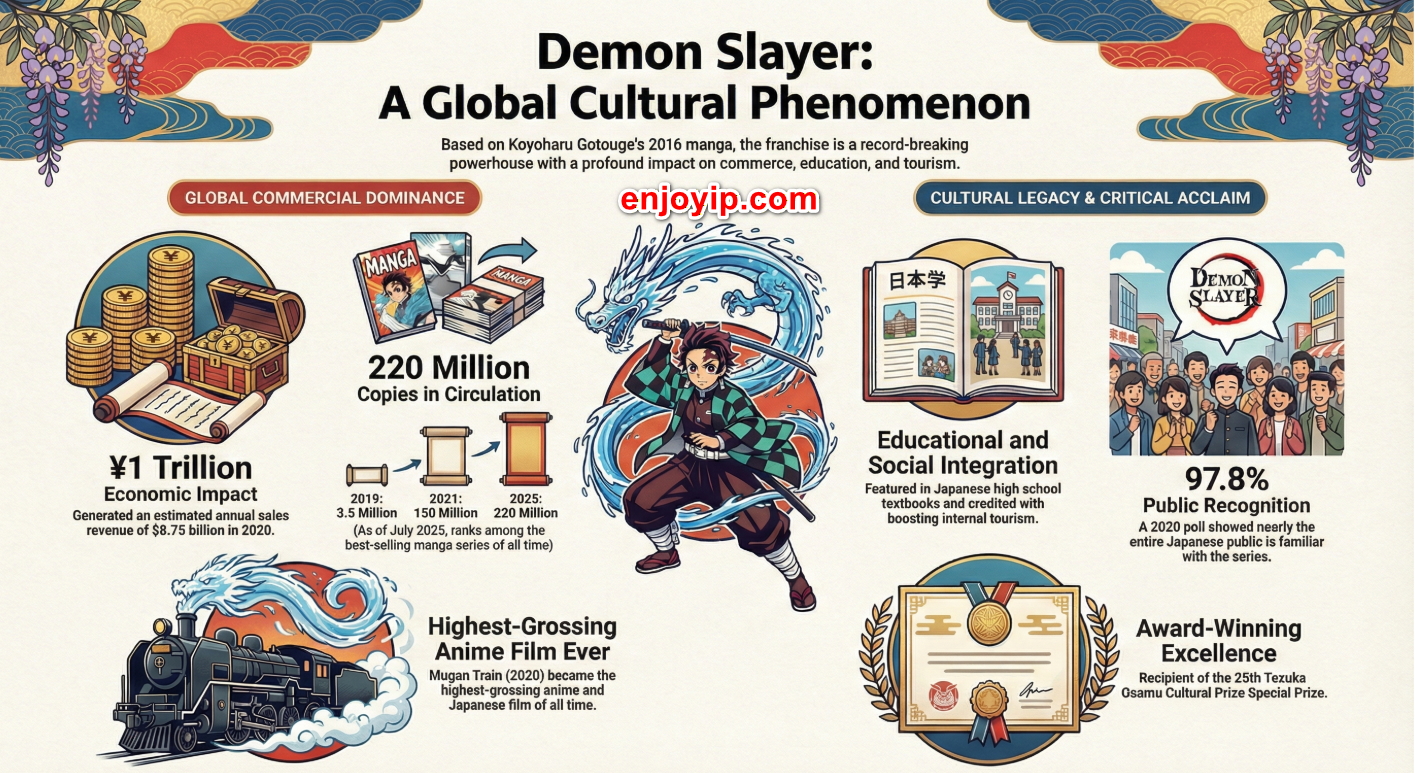
Cultural Impact Timeline

High-level milestones showing Demon Slayer: Kimetsu no Yaiba's global influence.
2016
Demon Slayer manga begins serialization in Weekly Shonen Jump
2019
Anime adaptation airs, becomes massive hit
2020
Demon Slayer: Mugen Train film breaks box office records
2021
Entertainment District Arc anime season
2023
Swordsmith Village Arc and Hashira Training Arc
2024
Final arc anime adaptation announced
Sales
Over 150 million manga copies sold worldwide
Revenue
Multi-billion dollar franchise
Awards
Anime of the Year, multiple animation awards

Key Characters

Meet representative characters from Demon Slayer: Kimetsu no Yaiba.
Tanjiro Kamado
I won't let anyone else die! I won't let anyone else get hurt!
A compassionate swordsman driven by empathy and determination.View Profile
Nezuko Kamado
Hmm! Hmm!
A demon who retains her human heart and protects humans.View Profile
Zenitsu Agatsuma
I hate myself more than anyone else does!
A fearful yet talented fighter who awakens under pressure.View Profile
Inosuke Hashibira
I'm the king of the mountains!
A fierce warrior raised in the mountains with wild instincts.View Profile
Giyu Tomioka
Those who regret their own actions... I will not let them be cut down.
The Water Hashira who first encountered Tanjiro and Nezuko, becoming Tanjiro's mentor.View Profile

Real-World Inspirations & Pilgrimage

⭐ Exclusive Guide
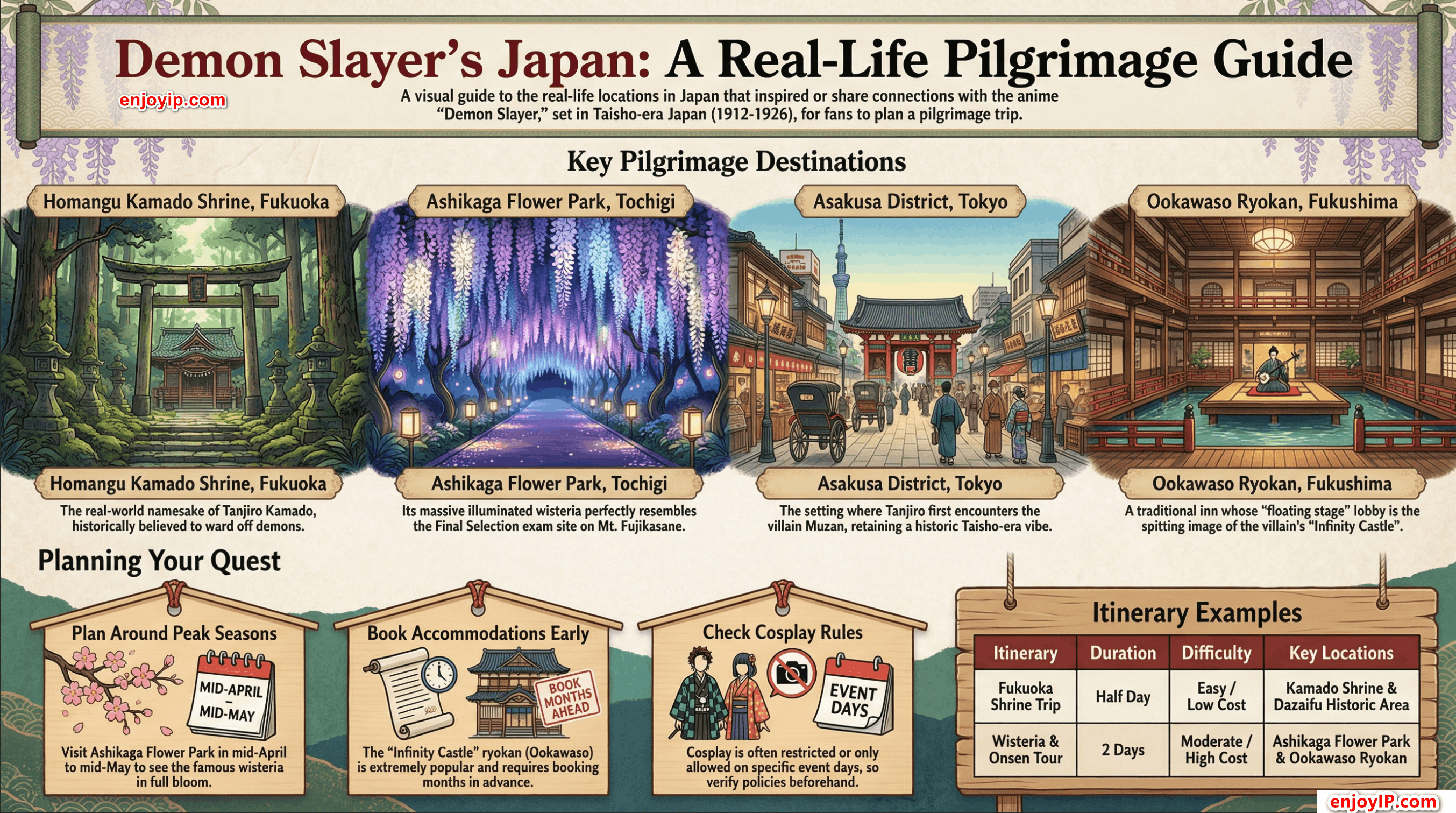
Discover real-world locations in Japan that inspired Demon Slayer’s world.
Demon Slayer Pilgrimage Guide
Spotlight Location Guide
  • Homangu Kamado Shrine (Dazaifu, Fukuoka)
  • Ashikaga Flower Park (Tochigi)
  • Asakusa – Taisho Era Vibe (Tokyo)
  • Ookawaso – Ashinomaki Onsen (Fukushima)
Locations are based on fan research, interviews, and cultural references.
View Full Pilgrimage Guide

Frequently Asked Questions

What is the main plot of Demon Slayer: Kimetsu no Yaiba?
Demon Slayer follows Tanjiro Kamado, a young boy who becomes a demon slayer after his family is slaughtered and his younger sister, Nezuko, is turned into a demon. His primary goal is to find a cure for Nezuko and defeat Muzan Kibutsuji, the Demon King responsible for the tragedy.
Who are the main characters in Demon Slayer?
The main protagonist is Tanjiro Kamado, accompanied by his demon sister Nezuko. They are joined by fellow demon slayers Zenitsu Agatsuma, a cowardly but powerful lightning user, and Inosuke Hashibira, a wild, boar-masked dual-wielder. The group is supported by the Hashira, the elite swordsmen of the Corps.
What genre is Demon Slayer classified as?
Demon Slayer is primarily a Shonen action series with heavy elements of dark fantasy, supernatural adventure, and historical fiction (set in the Taisho era). It blends intense sword-fighting action with emotional family drama.
Is Demon Slayer suitable for children?
The series is generally rated TV-14 or R-17+ depending on the region and medium. It contains significant graphic violence, gore (decapitations, dismemberment), and frightening imagery, making it more suitable for teens and adults than young children.
How many seasons and movies are there in Demon Slayer?
As of early 2024, the anime consists of Season 1 (Unwavering Resolve Arc), the Mugen Train movie (and TV arc), Season 2 (Entertainment District Arc), Season 3 (Swordsmith Village Arc), and Season 4 (Hashira Training Arc). A trilogy of movies adapting the final Infinity Castle Arc has been announced.
Who is the creator of Demon Slayer?
Demon Slayer: Kimetsu no Yaiba was created by Koyoharu Gotouge. The manga was serialized in Weekly Shonen Jump from February 2016 to May 2020.
What is the unique power system in Demon Slayer?
The series features 'Breathing Styles,' swordsmanship techniques that allow humans to match demons in strength by enhancing their oxygen intake and blood flow. Styles mimic elements like Water, Flame, Thunder, and the original Sun Breathing. Demons use 'Blood Demon Arts,' magical abilities fueled by their blood.
Why is the Demon Slayer: Mugen Train movie so famous?
Mugen Train is the highest-grossing anime film of all time worldwide and the highest-grossing film in Japanese history. It is renowned for its stunning animation by Ufotable, emotional storytelling involving the Flame Hashira Kyojuro Rengoku, and high-octane action sequences.
Where can I watch or read Demon Slayer?
The anime is widely available on streaming platforms like Crunchyroll, Netflix, and Hulu. The complete manga series is available in English through VIZ Media and the Shonen Jump app.
Why is Demon Slayer so popular?
Demon Slayer's popularity is attributed to its exceptional animation quality by studio Ufotable, fast-paced and straightforward storytelling, deeply empathetic protagonist, and the emotional weight placed on family bonds and the tragedy of both humans and demons.

Official & Related Links

Find official resources and trusted references to learn more.

Share the Joy and Fun!

Spread the word to your friends and community.